
Working with Okoume Boards: Cutting, Bending and Finishing
Okoume is the board you choose when the panel has to be shaped, finished and carried. Dongstar Wood's Okoume Plywood pairs a pale red to pinkish natural veneer with a relatively low density, quotes CE EN13986 compliance and E1 and E0 glues, and promises a smooth surface that accepts paints, stains, laminates and clear sealers.
Key takeaways
- A workshop's first question is answered by the face: okoume veneer in a warm pinkish red, evenly grained for consistent staining.
- The density: relatively low compared with many hardwood plywoods — easier to handle, dimensionally stable.
- The compliance: CE EN13986 supported, with E1 and E0 low-emission glues.
- The finishing: paints, stains, laminates and clear sealers all accepted.
Cutting okoume: calibrated veneers, clean edges
Cutting is where a board's internal quality becomes visible. The okoume page promises calibrated veneers and precision pressing, which means each layer is the thickness it was supposed to be and the panel comes off the press with a tight thickness tolerance. A board that is the right thickness everywhere cuts the same way everywhere.
The practical result shows up at the saw. A calibrated panel tracks straight, leaves a clean edge and does not tear the veneer on the exit side — the difference between a board that goes straight into the product and one that needs a second pass. For a shop running a cutting list of curved parts, that consistency is worth more than a small price difference. The tight thickness tolerance is the claim that matters most at the cutting saw: a panel that is the same thickness at every point tracks the same way through the blade, and the cut list written for one sheet fits the next — the consistency that lets a factory run a batch instead of a series of one-offs.
Bending and forming: what the low density buys
Okoume's density is described as relatively low compared with many hardwood plywoods, and that single property drives two behaviours a furniture maker cares about: the board is easier to handle on the shop floor, and it keeps its dimensional stability through the working. Low density is not a weakness here; it is the reason the board can be formed.
Bending is a stress test for any plywood. A board that bends without the face checking or the layers separating is a board whose veneers and glue are working together, and the okoume page's promise of precision pressing is what makes that behaviour repeatable from sheet to sheet — the property a production run actually needs. The forming behaviour is also a handling behaviour: a board that is easier to move around the shop floor is a board that arrives at the machine in better condition, and the low density that helps the bend also helps the carry.
Finishing: the pale red canvas
The face is natural Okoume veneer, warm pinkish-red in colour with consistent grain, and the page lists what it accepts: paints, stains, laminates, clear sealers. That list is a finishing department's menu — the board does not force a route, which means the finish can be chosen on design and cost grounds. The four routes are published so the finish can be chosen on design grounds.
Uniformity matters as much as colour. A face with a consistent grain structure takes stain evenly, which is the difference between a batch of chairs that match and a batch that has to be sorted by eye. The pale red tone also means a clear sealer shows the wood rather than fighting it, a route a light hardwood cannot always offer.
Compliance: CE EN13986 and the low-emission glues
The compliance line on the okoume page runs CE EN13986, with low-emission glues in E1 and E0. For a buyer selling into the European market, CE EN13986 is the construction-product conformity question answered in advance, and the E1/E0 options cover the emissions question a retailer or a specifier will ask next.
The timber story sits alongside the glue story. The page describes the Okoume as sourced from sustainably harvested timber, a species native to Africa, and for a buyer building a specification file that origin note is the kind of sentence a sustainability section quotes. The origin note is the kind of sentence a specification file quotes.
Where okoume boards end up
The product page lists applications spanning furniture — chairs, tables, cabinets, wardrobes — alongside interior panelling, ceiling panels and partitions, to joinery and architectural elements like doors, trims and decorative accents, and on to marine interiors and light construction: yacht cabinetry, boat interiors, lightweight structural elements.
Read as a maker, that list is a gradient of exposure. Furniture and joinery are dry interior work; panelling and ceilings are visible but protected; marine interiors are the demanding end, where the board meets humidity, salt air and the expectation of a yacht-grade finish. The same product line serves all three, which is the practical meaning of the range. The marine end of the list is where the compliance story and the finishing story meet: yacht cabinetry and boat interiors demand a board that finishes to a furniture standard in a humid environment, and the E1 and E0 glue options plus the CE EN13986 documentation are what make that combination specifiable rather than hopeful.
| Characteristic | Client's description | Workshop meaning |
|---|---|---|
| Face | Pale red to pinkish, uniform grain | Even staining, clear-sealer friendly |
| Density | Relatively low for a hardwood plywood | Easier handling, stable forming |
| Compliance | CE EN13986, E1 and E0 glues | European market documentation |
| Finishing | Paints, stains, laminates, clear sealers | Finish chosen on design, not forced |
Worked example: a furniture batch from one board spec
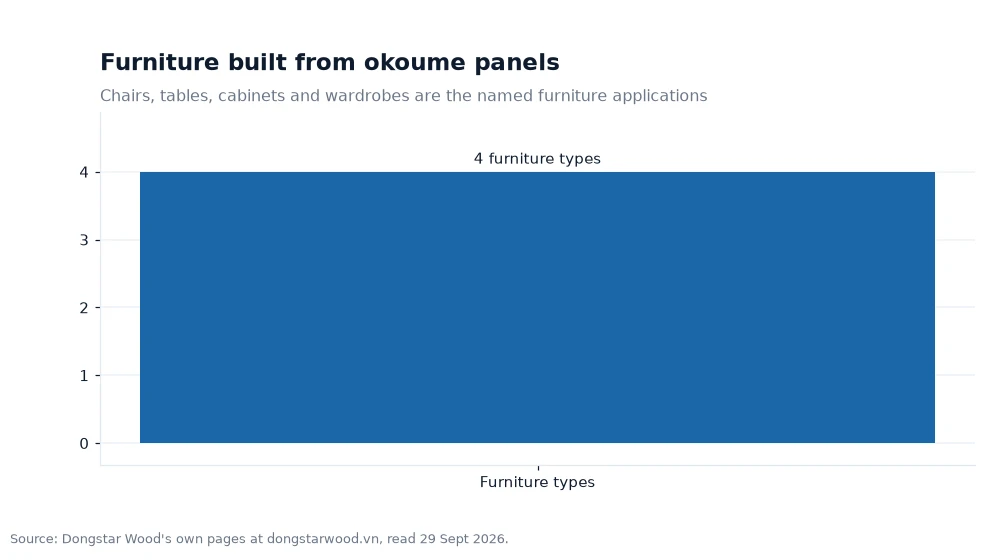
Plan a furniture batch from the format. The 1250 × 2500 mm sheet measures 1.25 m by 2.5 m, totalling 3.125 m², and the named furniture applications — chairs, tables, cabinets, wardrobes — are four product families drawing from one board spec. A programme running 100 chairs a month at 3.125 m² per chair needs 100 × 3.125 = 312.5 m² of panel a month, and the same line can supply the cabinet panels beside it.
Frequently asked questions
What does okoume's low density mean in the workshop?
The density is relatively low compared with many hardwood plywoods, so the board is easier to handle and keeps its dimensional stability through working. That combination is what allows the board to be formed and bent without the face checking or the layers separating.
Which compliance options come with okoume boards?
The page quotes CE EN13986 compliance, with low-emission glues in E1 and E0. The timber is described as sustainably harvested Okoume, a species native to Africa, which supports the sustainability section of a specification file.
What finishes can okoume boards take?
The natural pale red to pinkish veneer accepts paints, stains, laminates and clear sealers, and its uniform grain structure takes stain evenly. The finish can be chosen on design and cost grounds rather than being forced by the material.
Choosing the board for the shaping route
Okoume rewards a buyer who plans the shaping before the order. Read the company's own profile to inspect the operation behind the range, then look at the birch line to compare how a denser hardwood veneer behaves under the same cutting and finishing routes. Choose an Okoume Plywood Supplier whose published density, compliance and finishing options match the shaping route you have chosen. Buyers who match the board to the route tend to finish fewer panels twice.
Facts and figures were gathered from Dongstar Wood's product listings checked 29 Sept 2026[1].