
Six Private Label Fragrance Mistakes That Sink a Men's Line
Private label fragrance programmes fail in predictable ways: the same assumptions about masculinity, concentration and sample approval recur on almost every failed men's line. Most of these mistakes are fixable, but only before the bulk order, because after that the cost of correction stops being a negotiation item. The six mistakes below are the ones worth designing out of the programme before the first deposit.
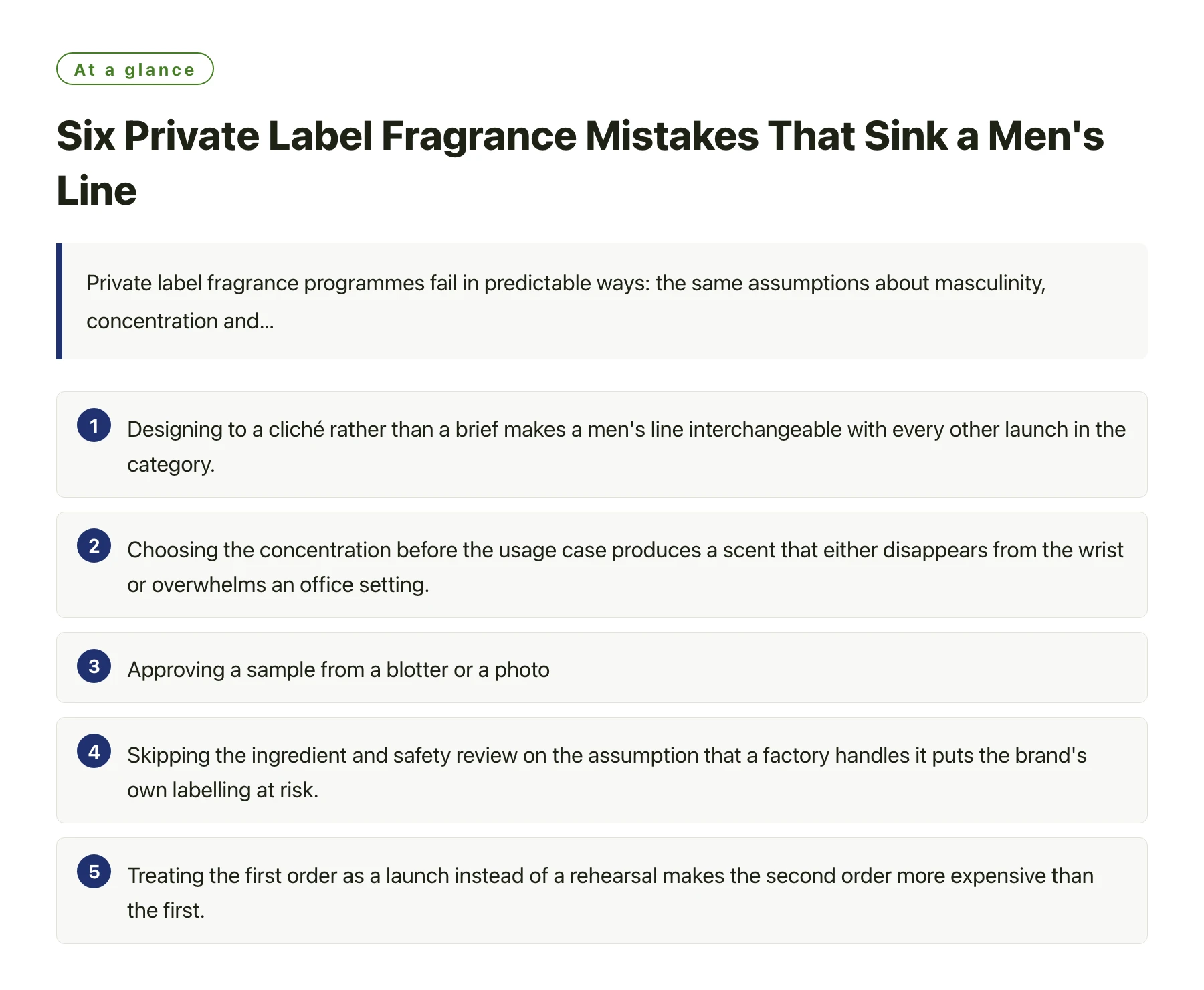
Key takeawaysDesigning to a cliché rather than a brief makes a men's line interchangeable with every other launch in the category. · Choosing the concentration before the usage case produces a scent that either disappears from the wrist or overwhelms an office setting. · Approving a sample from a blotter or a photo, without a skin test and a retained reference, invites disputes at the bulk stage. · Skipping the ingredient and safety review on the assumption that a factory handles it puts the brand's own labelling at risk. · Treating the first order as a launch instead of a rehearsal makes the second order more expensive than the first.
The private label route looks simple on paper: pick a scent, choose a bottle, wait for a pallet. The founders who lose money on it usually lose it on the same handful of decisions, repeated across different categories and different factories.
A men's line adds its own pressures. The category is crowded, the expectations around performance are high, and the scent itself carries assumptions about what masculine fragrance should smell like. Those assumptions are exactly where the mistakes live.
Here are the six patterns worth checking, each with the fix that costs less than the mistake.
The mistakes, in the order brands usually make them
- Opening with the cliché instead of the briefStarting from 'something woody and musky' produces a scent with no reason to exist. Start from the wearer, the moment and the difference you can defend, and let those narrow the accords.
- Picking the concentration before the usageAn eau de parfum strength scent that is worn at a desk behaves differently from one worn for an evening out. Decide where and how long the fragrance must last, then let that decide the concentration, not the other way around.
- Approving from a blotterAlcohol evaporates differently from skin, and citrus and marine notes shift the most. Test the sample on skin at least twice, at different times of day, and keep a sealed physical reference of the approved batch.
- Skipping the ingredient and safety reviewThe supplier compiles the ingredient list, but the brand owns the label in the destination market. Review the substance list against the labelling rules that apply to you before the artwork is finalised [1].
- Ignoring the skin-safety conversationPerfumery materials carry usage and concentration guidance for a reason; a supplier that cannot show how it applies that guidance is a risk you are inheriting [2].
- Treating the first order as the launchThe first production run should prove repeatability, lead time and paperwork. Brands that treat it as a dress rehearsal usually scale more smoothly than brands that treat it as a premiere.
Notice what these six mistakes share: none of them is a manufacturing defect. They are decision errors made while the programme still had room to manoeuvre. That is the reason the checklist above belongs before the bulk order, not after it.
How to keep a private label programme honest
The protection that works best is procedural. Write the brief down, define the approval reference, and record every iteration from first sample to final bulk. A programme that leaves a paper trail is harder to drift from.
It also helps to choose the partner deliberately. A supplier that offers a structured route from brief to shelf, rather than a catalogue of ready scents, is usually better at catching the mistakes above early. For a founder who wants the programme run properly, working with a private label partner for perfume lines means the quarterly checkpoints are theirs to enforce, not yours to invent.
And when you are choosing between factories, apply the same discipline you apply to scents. Compare how each one handles choosing a private label perfume partner on paper before you compare prices, because price differences are easier to interpret once the process questions are settled. A cheap first read is the manufacturer's own account of its scope and programme structure, which most credible suppliers publish openly — for a concrete example, the programme description on Xuelei's official site is a decent template for what the document should contain.
When the mistakes are worth making on purpose
Some of these choices are legitimate strategy in small doses. A deliberately generic scent can work for a low-price retail channel, and a short-lived fragrance can be the point for a summer product. What fails is making those choices by accident rather than by decision.
The review that catches the rest
Before the artwork is locked, run one pass through the programme with fresh eyes: scent brief, concentration, skin test results, ingredient list, retained reference, and the schedule back to launch. Ask one question at each step: is this what we decided, or what we drifted into?
Brands that run this final pass often discover that the catalogue of fixes they needed was already known to them at the start. The programme just never gave them a moment to write it down.
Sources
- EU CosIng — Cosmetic Ingredient Database (European Commission) —— The European Commission's CosIng database of cosmetic ingredients, listing ingredient functions, restrictions and labelling requirements under EU cosmetics law.
- IFRA: Safe Use and Fragrance Science —— IFRA's explanation of how fragrance materials are scientifically assessed for safe use and how those conclusions are applied by the industry.
Frequently asked questions
What is the biggest private label fragrance mistake for a first-time founder?
Approving the scent from a blotter and a photograph, then discovering at the bulk stage that the fragrance behaves differently on skin and after time in the bottle. Every other mistake is easier to correct than this one.
Should a men's line use a higher fragrance concentration?
Only if the usage case demands it. Concentration raises cost and affects how the scent develops. Decide how long the fragrance must last in the setting where it will actually be worn, then let that answer choose the concentration.
Who is responsible for the ingredient list on a private label product?
The manufacturer compiles it, but the brand is responsible for what appears on the label in the destination market. Review the substance list against the applicable labelling rules before finalising artwork.
How many sample rounds should a private label programme allow for?
Budget for three to five rounds in the schedule, and define what counts as a round in advance. The goal is not fewer rounds; it is rounds that move the scent closer to the brief rather than further from it.
Can the same mistakes be avoided when switching suppliers later?
Mostly yes, if the paper trail is intact: the brief, the approval reference and the ingredient list travel with the brand. That is why the retained sample and the written brief are the two documents to protect.
Yours at the desk,
admin
Slow letters for slow writers.
One contemplative essay, one craft prompt, one quiet recommendation — delivered each Sunday morning to readers who treat writing as a way of seeing.
Join the Inkwell — Free Weekly Letters